sat suite question viewer
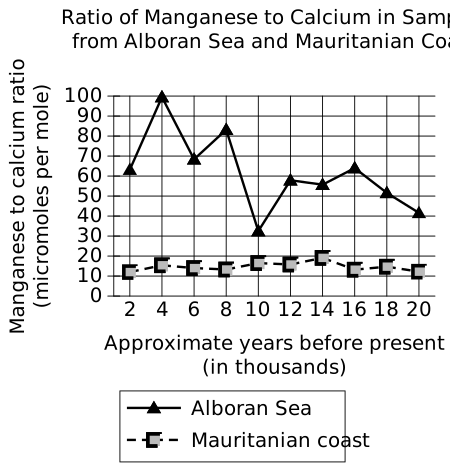
- The following 2 lines are shown:
- Alboran Sea
- Mauritanian coast
- The Alboran Sea line:
- Begins at 2 thousand, 63.2 micromoles per mole
- Rises sharply to 4 thousand, 99.5 micromoles per mole
- Falls sharply to 6 thousand, 68.4 micromoles per mole
- Rises sharply to 8 thousand, 83.2 micromoles per mole
- Falls sharply to 10 thousand, 32.5 micromoles per mole
- Rises sharply to 12 thousand, 57.9 micromoles per mole
- Falls gradually to 14 thousand, 55.7 micromoles per mole
- Rises gradually to 16 thousand, 64 micromoles per mole
- Falls sharply to 18 thousand, 51.6 micromoles per mole
- Falls sharply to 20 thousand, 41.6 micromoles per mole
- The Mauritanian coast line:
- Begins at 2 thousand, 12 micromoles per mole
- Rises gradually to 4 thousand, 15.4 micromoles per mole
- Falls gradually to 6 thousand, 14 micromoles per mole
- Falls gradually to 8 thousand, 13.3 micromoles per mole
- Rises gradually to 10 thousand, 16.5 micromoles per mole
- Falls gradually to 12 thousand, 15.8 micromoles per mole
- Rises gradually to 14 thousand, 19.1 micromoles per mole
- Falls gradually to 16 thousand, 13.2 micromoles per mole
- Rises gradually to 18 thousand, 14.7 micromoles per mole
- Falls gradually to 20 thousand, 12.2 micromoles per mole
The population of the coral Lophelia pertusa declined significantly around 9,000 years ago in the Alboran Sea and around 11,000 years ago near the Mauritanian coast. Using the ratio of manganese to calcium, which inversely correlates with ocean oxygenation levels, marine scientist Rodrigo da Costa Portilho-Ramos and colleagues evaluated whether oxygenation played a role in the declines of L. pertusa. The researchers concluded that oxygenation may have been important in the Alboran Sea but not near the Mauritanian coast, since blank
Which choice most effectively uses data from the graph to complete the statement?
Explanation
Choice B is the best answer because it effectively uses data from the graph to complete the statement about Rodrigo da Costa Portilho-Ramos and colleagues’ conclusion. The graph shows the ratio of manganese to calcium in L. pertusa coral samples from the Alboran Sea and the Mauritanian coast. The graph reflects time in approximate years before present: in other words, the greater the number in years noted on the graph’s horizontal axis, the farther that moment is in the past. The text indicates that the researchers tested the samples to determine whether oxygenation played a role in the decline of L. pertusa. The text goes on to note that a change in the ratio of manganese to calcium would signal an inverse, or opposite, change in oxygenation. According to the graph, the ratio of manganese to calcium in samples from the Alboran Sea increased from about 30 micromoles per mole 10,000 years ago to about 80 micromoles per mole 8,000 years ago, which means that oxygenation decreased between 10,000 and 8,000 years ago. Meanwhile, there was almost no discernible change in the ratio of manganese to calcium in samples from the Mauritanian coast between 12,000 and 10,000 years ago. According to the text, the population of L. pertusa declined significantly around 9,000 years ago in the Alboran Sea and around 11,000 years ago near the Mauritanian coast. Thus, the increase in the ratio of manganese to calcium around 9,000 years ago in the Alboran Sea coincides with the decline in the L. pertusa population, suggesting an association between the decrease in oxygenation and the decline in population of the coral. No such relationship is suggested around 11,000 years ago near the Mauritanian coast. So, oxygenation likely played a role in the L. pertusa decline in the Alboran Sea but not in the coral’s decline near the Mauritanian coast.
Choice A is incorrect because it asserts the opposite of what the graph indicates regarding oxygenation in the Alboran Sea, and it misrepresents what the graph indicates about oxygenation near the Mauritanian coast. The graph indicates that at the time of the decline in L. pertusa (approximately 9,000 years ago), the samples from the Alboran Sea contained a ratio of manganese to calcium that was increasing. According to the text, this ratio inversely correlates with ocean oxygenation levels, so if the ratio was increasing, oxygenation was decreasing, not substantially increasing. Furthermore, the graph shows that the ratio of manganese to calcium remained relatively stable in coral samples from the Mauritanian coast during the period studied, which suggests that there was no discernible relationship between oxygenation and the coral’s population decline in that location, not that there was a substantial decrease in oxygenation corresponding to the coral’s decline. Choice C is incorrect. Although the graph suggests that the level of oxygenation in the Alboran Sea was higher before the decline in L. pertusa than after—because the ratio of manganese to calcium inversely correlates with ocean oxygenation levels and this ratio was lower before the decline than after—the graph doesn’t support the claim that oxygenation near the Mauritanian coast was consistently low before and after the coral’s decline there. Rather, the graph indicates that relative to coral samples from the Alboran Sea, the ratio of manganese to calcium in samples from near the Mauritanian coast was consistently low, which suggests that oxygenation levels were relatively high both before and after the decline of L. pertusa. Choice D is incorrect because it states the opposite of what the graph indicates: the graph shows that throughout the period studied, the ratio of manganese to calcium was higher in coral samples from the Alboran Sea than it was in samples from near the Mauritanian coast. Since the text indicates that the ratio of manganese to calcium inversely correlates with ocean oxygenation levels, oxygenation in the Alboran Sea was therefore lower than, not higher than, oxygenation near the Mauritanian coast during the period studied. Moreover, even if choice D did accurately represent the graph, it wouldn’t effectively complete the statement since a comparison of the ocean oxygenation levels at the two locations is not relevant to the claim that a decline in oxygenation levels was associated with the decline of L. pertusa in the Alboran Sea but not near the Mauritanian coast.